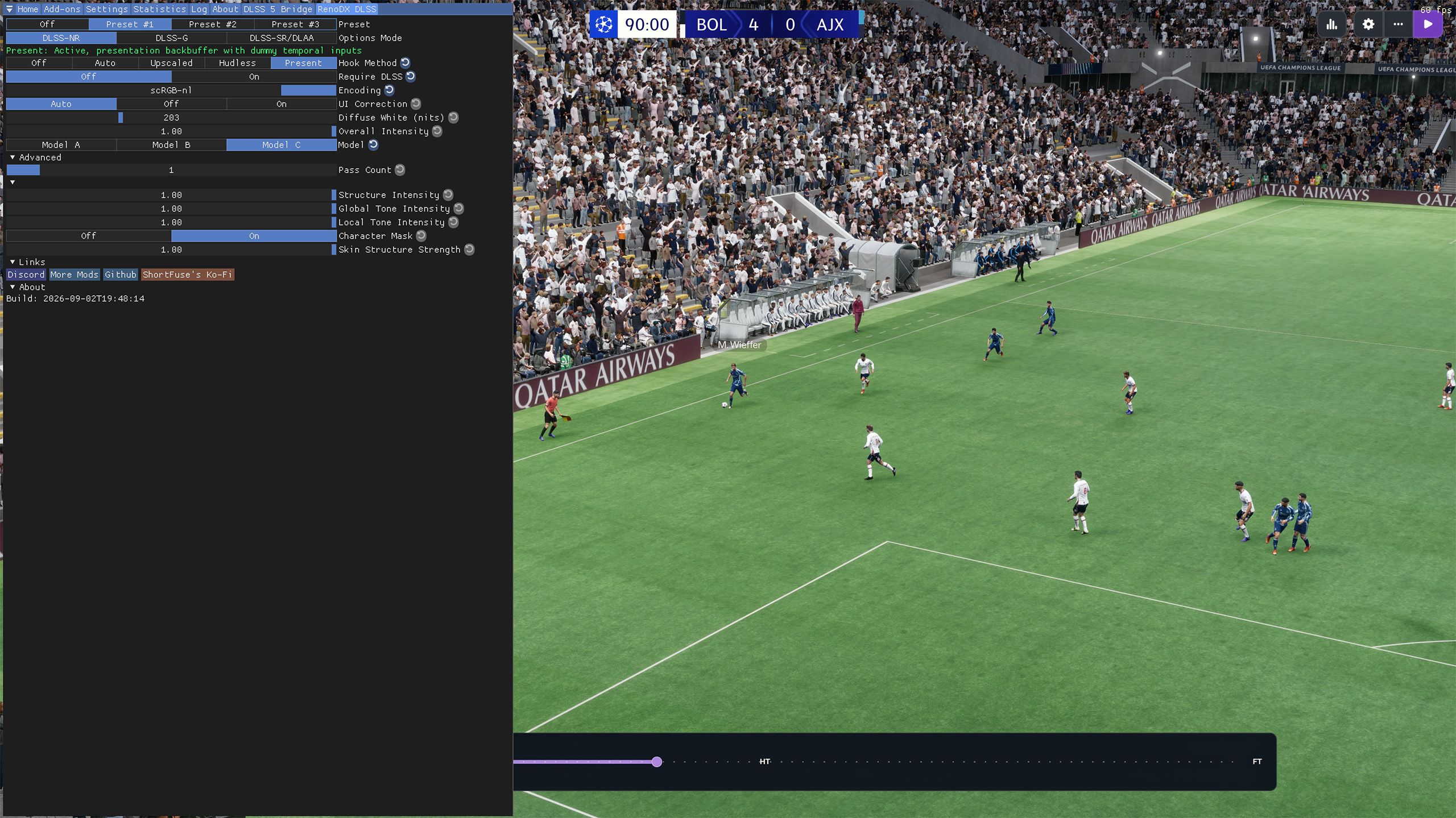
DLSS 5 can be jammed into almost any game now, so I’ve been playing FM26 with neural rendered little computer people because that’s just what I do
DLSS 5, Nvidia’s neural rendering upscaling technology, can now be installed into games that don’t officially support it by injecting the released .dll files directly, opening new possibilities for experimentation across a wide range of titles.
The method was inspired by a Control mod and has enabled developers and enthusiasts to test DLSS 5 compatibility in games never intended to support the technology. Results are highly inconsistent—the feature works effectively in some titles but produces significant visual artifacts in others, including what has been described as disturbing character distortion that resembles skin deformations.
Testing has included unexpected applications like Football Manager 26, where the neural rendering processes the game’s player models, and The Blood of Dawnwalker, where improper implementation of DLSS 5’s motion vectors and scene depth handling created unintended visual effects. While these artifacts can occasionally produce interesting aesthetic results—such as enhancing undead character designs—they more often render games unplayable or visually unacceptable.
The core issue lies in DLSS 5’s technical requirements: the technology relies on proper motion vectors and scene depth data to function correctly. When games don’t provide this data natively, the neural rendering pipeline fails to hook properly, resulting in visual degradation. This highlights both the potential flexibility of the technology and the importance of proper engine integration.
While this workaround demonstrates the portability of DLSS 5’s underlying technology, it remains a proof-of-concept rather than a practical solution for most games. Official support from developers remains the standard path for stable implementation.